Abundant software, uncertain economics
in Technology

There has been a lot of speculation about the future of software development and knowledge work recently. I have been a software developer for 10+ years and ran a venture-backed SaaS startup for 4+ years that got acquired. Naturally, I am trying to make sense of it all.
With respect to software development in particular, different questions often get muddled up. I realized this during a spirited discussion with a friend. These questions are:
- Will software as an artefact remain valuable?
- Will software development continue to be an economically valuable professional trade/craft?
- Will businesses where software is the primary differentiator, not physical hardware or operations, remain valuable?
These are all related but looking at them separately from first principles helps me clear my head.
Software as an artefact
This one’s easy. Software is not going away. The hosts (think R2-D2 or Hal) or interfaces (e.g. voice) will change dramatically but consumption of software should continue to trend up. By consumption, I don’t necessarily mean us staring at screens.
Optimistically, the increased usage can take the form of proactive assistants, background agents or robots making lives easier across economic levels. We will need new interfaces, delivery mechanisms and economic models. The evolution will be rapid and humanity’s going to ask for better software.
As software becomes cheaper to produce, we build more of it. Something that was not worth automating before can be automated. Irrespective of who builds it or who makes money from it, software should become more abundant.
Software development jobs
The question is not whether software development remains useful. It obviously will. The question is whether it remains economically valuable as a primary skill for as many individual developers as it is today. My current hunch is no.
The last few months have been a whirlwind. Meaningful parts of software development have been automated across companies of all sizes. The craft is evolving even if the opinions about the direction differ. Agents can write code, navigate repositories, debug problems and increasingly execute longer-running tasks.
You still need human developers to call the shots, with or without an army of agents, to build and operate meaningful production software in 2026. Theoretically, far fewer people can generate the same amount of output compared to a couple of years back though.
AI also makes software development capability accessible to people who would never have become professional programmers. Provided a foundational platform exists, end users should be able to direct their agents to customize software they own or subscribe to.
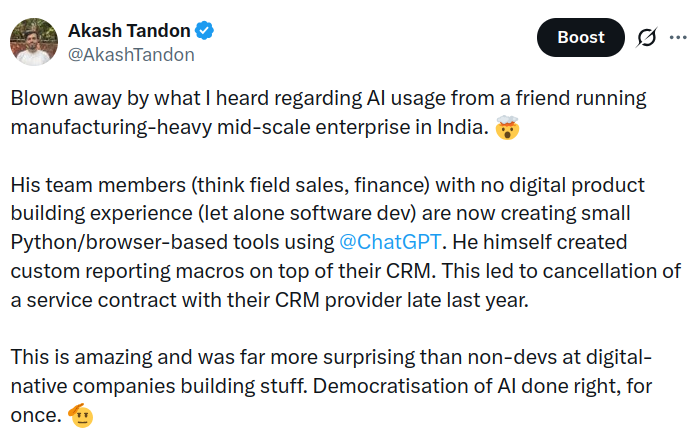
The economic benefits of software development may accrue to a smaller group of people tackling problems where technical judgment and depth remain scarce. The ability to build software itself diffuses across a much larger group as a secondary skill.
Software companies
The recent downturn where traditional software companies lost market value, poetically termed SaaSocalypse, led many to believe that software businesses* won’t be valuable in future.
I don’t believe this. Software companies can and will generate significant market value in the future. Increased software consumption helps but that is not enough. As building software gets easier, the ability to create software itself becomes less scarce. Most of a company’s alpha will have to come from what surrounds the software. This means distribution, proprietary data, workflow ownership, customer relationships, trust or deep expertise in a particular problem.
There’s also the matter of focus. Companies with heavy hardware or operations focus will still benefit from vendors doing the heavy-lifting on the software front instead of building everything in-house.
AI-driven changes could make software companies easier to start but harder to defend on the strength of good software products alone. I still expect significant market value to be created by software companies but the number of highly valuable ones may not grow in proportion to the amount of software being created and consumed.
*By “software businesses”, I mean companies whose primary differentiator is software services or products as opposed to hardware or operations. This definition is fuzzy but bear with me for the sake of simplicity.
Road ahead
The above points are about the future 4-5 years from now. We are likely to consume more software while needing less human effort to produce it. But more software does not automatically imply more software developers or more economic benefits for software companies.
If you are someone who loves software development, feel free to ignore the above and continue to focus on your craft. The world needs good software more than ever even if it doesn’t need as many developers.
Predictions regarding AI are as good as the roll of a dice at this point. However, a mental model is helpful as an individual. Feel free to poke holes in mine.
Thanks to Ankita for reading the draft.