<?xml version="1.0" encoding="utf-8"?><feed xmlns="http://www.w3.org/2005/Atom" xml:lang="en"><generator uri="https://jekyllrb.com/" version="3.10.0">Jekyll</generator><link href="https://analyticalmonk.github.io/feed.xml" rel="self" type="application/atom+xml" /><link href="https://analyticalmonk.github.io/" rel="alternate" type="text/html" hreflang="en" /><updated>2026-06-06T14:45:59+00:00</updated><id>https://analyticalmonk.github.io/feed.xml</id><title type="html">Akash Tandon</title><subtitle>The personal website of Akash Tandon. Writings, work and some other bits of relevant information.
</subtitle><author><name>Akash Tandon</name></author><entry><title type="html">Four years a founder - Time</title><link href="https://analyticalmonk.github.io/startup/2025-01-05-four-year-founder-time/" rel="alternate" type="text/html" title="Four years a founder - Time" /><published>2025-01-05T00:00:00+00:00</published><updated>2025-01-05T00:00:00+00:00</updated><id>https://analyticalmonk.github.io/startup/four-year-founder-time</id><content type="html" xml:base="https://analyticalmonk.github.io/startup/2025-01-05-four-year-founder-time/"><![CDATA[<p><em>Note: This is part of a series of blog posts which are descriptive rather than prescriptive. Don’t consider them as advice.</em></p>

<p>Context is important. This post is about my experience as a tech startup co-founder for the past 4 years. I spent my late 20s with the former as my primary identity, for better or worse.</p>

<p>I am 31 years old, and based out of India. I have been a misfit since much of my adolescence in most social situations. I had a middle class upbringing and spent much of my childhood in tier-2 cities. I am fascinated by technology, especially AI, and its impact on the human experience.</p>

<p>My startup, <a href="https://looppanel.com">Looppanel</a>, operates remotely and was started in late 2021 during the pandemic and is VC-backed. Along with an amazing team, I am responsible for ensuring that we solve our customer’s problems by building the best possible product using the best available technology. We serve customers in more than a dozen countries in 6 continents including large enterprises and some names that you would have heard of.</p>

<h2 id="overview">Overview</h2>

<p>The startup experience is interesting because you don’t just learn new things, you get to dig deeper into the meaning of lessons you already knew.</p>

<p>Three big learnings in my journey are related to time. They are:</p>

<ul>
  <li>Timing matters</li>
  <li>Accept the past</li>
  <li>Good things take time</li>
</ul>

<p>Over the last few years, I faced situations with an intensity and frequency which instilled a deep appreciation of the above principles.</p>

<h2 id="timing-matters">Timing matters</h2>

<p>The most tactical and frequent way I have seen the importance of timing play out at Looppanel is when prioritising product decisions. We frequently make decisions, right and wrong, to deal with unexpected occurrences such as sales requirements or taking advantage of a market tailwind. The scale of the relevant time period in such situations can vary from hours to years.</p>

<p>If you do something a week later than it was supposed to be done, it may turn out to be meaningless. If you are too early to market, you will struggle. We were early when we introduced our AI features and struggled with customer scepticism. As AI became mainstream, our approach gained wide acceptance quickly.</p>

<p>This principle plays out in personal life too. A difference in personal situations compared to professional life is you can’t and maybe shouldn’t rely on logic as much. Your gut/heart can often give a better answer than cold reasoning would. This can mean something as simple as returning a friend’s call when they need you for a few minutes instead of waiting until the weekend.</p>

<p>Shifting back to work, Looppanel benefited from starting up during a global lockdown. Our product’s first version was a meeting assistant and analysis tool for user research calls. We were able to get our first customer even before I wrote any code.<br />
<em>Related: <a href="https://avichal.com/2017/11/27/why-now/">Why now?</a></em></p>

<p>On the flip side, I am also aware of multiple startups that started before the 2020 pandemic with a similar idea and struggled simply because not enough research sessions were being conducted remotely. This leads me to my second learning about time.</p>

<h2 id="accept-the-past">Accept the past</h2>

<p>You may understand the importance of timing and take decisions to the best of your ability. You will still often be wrong and plans won’t work out. For example, when starting Looppanel, we focused on building the best possible product for a significant time period at the expense of monetization. There’s no substitute for building a great product early on but we could have revised our business goals earlier than we did.</p>

<p>There have also been times when I made a decision informed by emotion instead of objectivity. I can recall more instances from work where I wish I’d acted differently. Such wishful thinking isn’t productive though. It’s great to learn from the past but obsessing over it is wasteful at best and destructive at worst.</p>

<p>In hindsight, I should have managed my personal relationships differently over the last few years as well. I became comfortably distant from a lot of friends and family members. As an introverted person, it didn’t help that I spent much of the pandemic starting a startup and writing an <a href="https://www.oreilly.com/library/view/advanced-analytics-with/9781098103644/">O’Reilly book</a>. All I can do now is to mend relationships to the best of my abilities and look forward.</p>

<p>A habit that’s helped me immensely with managing my emotions about the past is journaling. You can’t always shut down how you feel but writing about it can be therapeutic.</p>

<h2 id="good-things-take-time">Good things take time</h2>

<p>We have all heard this since childhood. It’s hard to live it though. This is especially true in the startup world where ‘overnight’ successes and rapid growth are celebrated with an almost religious fervour.</p>

<p>I distinctly recall an entrepreneurship lecture at my college where a business owner had mentioned that if your company survives its first 3 years, the chances of becoming successful become disproportionately high compared to the average. More recently, I recall Michael Seibel from YCombinator mentioning how the period from 18 to 36 months is the toughest for most first-time startup founders, including ones which eventually succeed. I have experienced this first-hand in the last 3 years.</p>

<p>2024 has been the most successful year of Looppanel by a distance. Much of our success is built on the foundation we laid for ourselves as individuals, a team and a company previously. This includes learning from the failures we endured. Even then, it was harder to envision, if not hope or believe, this success at the beginning of last year.</p>

<p>At a personal level, it would’ve helped immensely had I been half as good at thinking about building products and empathizing with users, not just application of technology, when we’d started out. However, I needed time and experience to become better.</p>

<h2 id="summing-up">Summing up</h2>

<p>While hard work is often overrated in the professional sphere, persistence or grit is underrated, particularly in startups. The best results (and stories) emerge not just from working hard, but from staying in the game long enough and remaining mindful of timing.<br />
<em>Note: Knowing when to give up is equally important but more on that later.</em></p>

<p>The startup journey has taught me about understanding when to move, accepting what you can’t change, and having the grit to persist when immediate results aren’t visible. This is true as much for building a company as it’s for living your life.</p>]]></content><author><name>Akash Tandon</name></author><category term="startup" /><summary type="html"><![CDATA[Learnings and anecdotes from four years as a startup founder - timing matters, accept the past and good things take time.]]></summary><media:thumbnail xmlns:media="http://search.yahoo.com/mrss/" url="https://analyticalmonk.github.io/assets/gare_nord_clock.jpg" /><media:content medium="image" url="https://analyticalmonk.github.io/assets/gare_nord_clock.jpg" xmlns:media="http://search.yahoo.com/mrss/" /></entry><entry><title type="html">Lessons from building an AI feature that works - chunking and summarization</title><link href="https://analyticalmonk.github.io/ai/2024-06-23-lessons-from-building-ai-feature-that-works-chunking-summarization/" rel="alternate" type="text/html" title="Lessons from building an AI feature that works - chunking and summarization" /><published>2024-06-23T00:00:00+00:00</published><updated>2024-06-23T00:00:00+00:00</updated><id>https://analyticalmonk.github.io/ai/lessons-from-building-ai-feature-that-works-chunking-summarization</id><content type="html" xml:base="https://analyticalmonk.github.io/ai/2024-06-23-lessons-from-building-ai-feature-that-works-chunking-summarization/"><![CDATA[<p>It’s been over a year since my team at <a href="https://www.looppanel.com/">Looppanel</a> shipped our first LLM-powered feature. We have added more such capabilities since then but the first one taught us some lessons that are worth sharing.</p>

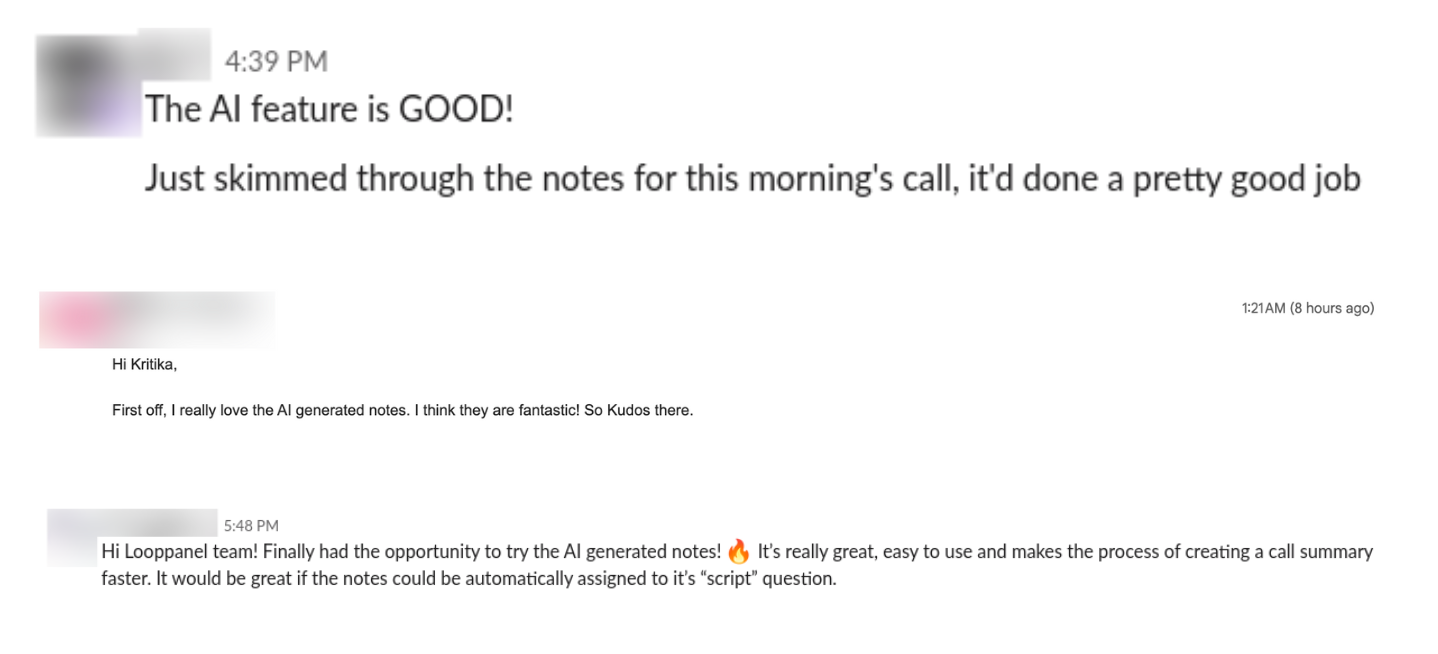
<p>The feature I’m referencing - AI notes - generates high-quality notes on top of user interview transcripts. Many of our users tried out similar tools but told us over and over that our version was superior.</p>

<p><img src="/assets/img/ai_notes_feedback.png" alt="Looppanel AI notes feedback" /></p>

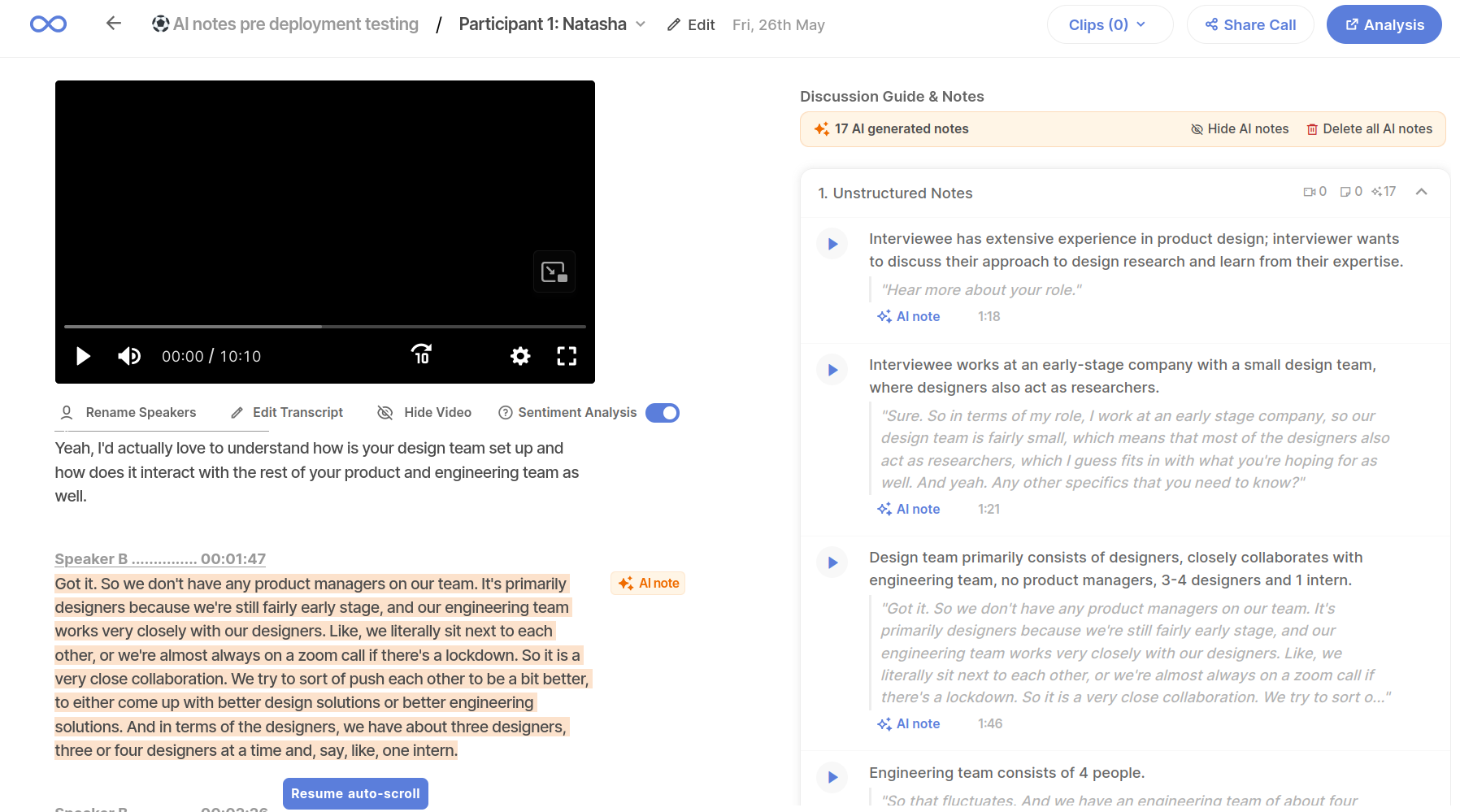
<p>To someone who’s not analyzing user research data, these notes will not appear to be any different than those from a <a href="https://www.zoom.com/en/ai-assistant/">generic AI meeting assistant</a>.</p>

<p><img src="/assets/img/ai_note_demo_screenshot.png" alt="Looppanel AI notes" /></p>

<p>When our user looks at these notes, there are 2 aspects that they often evaluate them on - does the note capture a relevant part of the interview (chunking), and does the note describe the part correctly and objectively (summarization)? These 2 aspects are what we will dive a little deeper into.</p>

<p>Specifically, we will talk about 2 components of our AI notes pipeline - chunking and summarization - and lessons learnt while building them. <strong>These components also highlight how crucial data transformation/engineering and user experience (UX) are for an LLM-based feature in addition to the underlying model.</strong></p>

<p><em>Note: please keep in mind that a lot more work went into making a successful feature in addition to the 2 components being discussed. They stand out from a technical and product POV but are only pieces of a bigger puzzle which involves user research, design and software development. In addition, I am not sharing the specific technical implementation but a high level overview and lessons. I hope that you will be able to apply them to your specific situation if relevant.</em></p>

<h2 id="chunking">Chunking</h2>

<p>Search for ‘chunking text for LLMs’ and you will come across many <a href="https://www.pinecone.io/learn/chunking-strategies/">articles</a> and <a href="https://python.langchain.com/v0.2/docs/concepts/#text-splitters">documentation pages</a>. They describe multiple methods to break down text documents into smaller parts (chunks). Chunking is mostly talked about in the context of <a href="https://stackoverflow.blog/2024/06/06/breaking-up-is-hard-to-do-chunking-in-rag-applications/">RAG or search</a>.</p>

<p>In our case, we were doing a version of text <a href="https://en.wikipedia.org/wiki/Text_mining">mining</a>. We wanted to break down a user interview transcript into multiple chunks. Each chunk needed to make sense as a semantic unit in context of the entire interview. It was early 2023 and we were severely restricted by context length and semantic boundaries.</p>

<p><em>Note: 4k context length limit sounds like a distant memory compared to the 100k+ limits that have become <a href="https://www.reddit.com/r/MachineLearning/comments/1c7pzf0/discussion_are_there_specific_technicalscientific/">the norm for large language models</a> now.</em></p>

<p><a href="https://python.langchain.com/v0.2/docs/how_to/semantic-chunker/">Semantic chunking</a> sounded cool as a concept but out-of-the-box implementations didn’t satisfy our use case, same as all of the other techniques on offer. For example, if you simply broke down a conversation based on number of sentences or even semantic similarity, there was a high probability that the natural flow of the conversation would not be captured. This would result in the end user spending signficant cognitive energy reviewing the chunks and the corresponding notes.</p>

<p>With user context and use case in mind, we wrote a chunking implementation that specifically worked for user interviews. <strong>It accounted for distinction between interviewer and interviewee speech, and identified topic changes in the conversation, to find relevant boundaries. This was an example of a domain-specific chunking methodology.</strong></p>

<p>The output from this method made a lot of sense for the users and their relevance contributed to not just AI notes but multiple features that we built afterwards.</p>

<h2 id="summarization">Summarization</h2>

<p>Summaries of text documents are seen as a commodity at this point. I am fascinated by how the term can take different meanings based on the use case and who they are meant for. For us, chunking was technically challenging but generating the summary text turned out to be one of the most nuanced parts from a user experience perspective.</p>

<p><strong>In addition to correctness, a user can care deeply about the tone, length, and choice of words of a summary.</strong> If you don’t get this right, the user will not care about all the fancy data engineering or modelling work you may have done until that point.</p>

<p><img src="/assets/img/looppanel_ai_notes_single.png" alt="Single AI note" /></p>

<p>This is something we learnt after releasing a beta version. The beta users would fixate on the language of notes and ignore everything else. We iterated multiple times on relevant prompts used to create the summary by experimenting with the length, tone, etc.</p>

<p>In hindsight, I would’ve leveraged domain expertise earlier and a lot more to finalize the prompts used to generate the note text that a user read. That’s the approach we ended up taking for similar problem statements since then.</p>

<h2 id="wrapping-up">Wrapping up</h2>

<p>LLMs are evolving rapidly and so is the ecosystem and user expectations around them. When building an LLM-powered product, technology can play an even bigger role than has been the norm in the last decade or so. Hence, it gets easier to ignore the user experience when working on an AI product more than usual. However, building something that actually works involves maintaining a fine balance between the technology and UX.</p>]]></content><author><name>Akash Tandon</name></author><category term="ai" /><summary type="html"><![CDATA[Lessons from creating a successful LLM-based feature for breaking down and summarizing user interviews, emphasizing how we nailed it by focusing on context, user feedback, and the right balance of AI and user experience.]]></summary><media:thumbnail xmlns:media="http://search.yahoo.com/mrss/" url="https://analyticalmonk.github.io/assets/img/robotlab_writing_robot.jpg" /><media:content medium="image" url="https://analyticalmonk.github.io/assets/img/robotlab_writing_robot.jpg" xmlns:media="http://search.yahoo.com/mrss/" /></entry><entry><title type="html">Brief lessons from using LLM APIs in production</title><link href="https://analyticalmonk.github.io/ai/2023-08-20-lessons-llm-production/" rel="alternate" type="text/html" title="Brief lessons from using LLM APIs in production" /><published>2023-08-20T00:00:00+00:00</published><updated>2023-08-20T00:00:00+00:00</updated><id>https://analyticalmonk.github.io/ai/lessons-llm-production</id><content type="html" xml:base="https://analyticalmonk.github.io/ai/2023-08-20-lessons-llm-production/"><![CDATA[<p>One day, I will write a nuanced post about using large language models in production. It will be better than all the nuanced posts published so far about using large language models in production. Until then, here are some brief lessons learnt from building and operating LLM APIs in a production environment for the last 6 months.</p>

<p><em>Note: As hard as it may be for you to believe, the above introduction was written by a human. Or not. It’s <a href="https://decrypt.co/149826/openai-quietly-shutters-its-ai-detection-tool">hard to tell</a>.</em></p>

<p><strong>Outline</strong></p>
<ol>
  <li>Chat isn’t always the answer</li>
  <li>You don’t need to know everything<br />
a. It doesn’t hurt to know a bit more than you need</li>
  <li>Tinker</li>
  <li>Open source is your friend but APIs are not your enemy</li>
  <li>Demos will take a weekend, production will keep you up on weekends</li>
</ol>

<p><strong>Lesson 1: Chat isn’t always the answer</strong></p>

<p>By now, you must know. If you don’t, you sure should be glad that you are reading this. You probably don’t need to make ChatGPT for X. Maybe you do. Most probably, you don’t.</p>

<p>Chat can be great because it’s flexible. For a lot of use-cases, it’s not great because it’s too flexible. Your users don’t always want to stare at a canvas of infinite possibilities. Sometimes, they need help. If they want to get their professional work done, they definitely could use some help.</p>

<p>What interface do they need then? I don’t know. That’s for you to figure out by <a href="https://www.momtestbook.com?ref=akashtandon.in">talking with them</a>. I can only provide great lessons, not answers.</p>

<p><em>Note: Here’s what we have built at <a href="https://www.looppanel.com?ref=akashtandon.in">Looppanel</a>. We don’t allow our users to talk with their interview transcripts. Not yet anyway.
Instead, we provide them with meaningful interview notes tied to evidence (transcript text and timestamp) and their inputs (themes and questions). <a href="https://en.wikipedia.org/wiki/Hallucination_(artificial_intelligence)">Hallucination</a> isn’t an option when your job is to find out the truth.</em></p>

<p><img src="/assets/img/ai_note_demo_screenshot.png" alt="Looppanel AI notes" /></p>

<p><strong>Lesson 2: You don’t need to know everything</strong></p>

<p>There’s too much happening all the time. I am not talking about the significant issues of global warming or geopolitics. I am referring to your X (previously Twitter) feed and <a href="https://arxiv.org/list/cs.AI/recent">Arxiv</a>.</p>

<p>You tried but are barely able to keep up. That’s okay. If you try too hard to drink from a firehose, there’s a chance that you will drown.</p>

<p>First, try to figure out what you need to know to make whatever it is you need to make.</p>

<p><strong>Lesson 2a: It doesn’t hurt to know a little extra</strong></p>

<p>It’s okay to not know what <a href="https://www.promptingguide.ai/techniques/rag?ref=akashtandon.in">RAG</a> stands for and why <a href="https://www.cbinsights.com/research/generative-ai-infrastructure-vector-database/">vector databases are the talk of VC town</a>. However, if you have a rudimentary understanding of <a href="https://platform.openai.com/docs/guides/embeddings">embeddings</a>, that will be helpful if a potential business use-case presents itself.</p>

<p>Skim <a href="https://twitter.com/karpathy/">Andrej Karpathy</a> and <a href="https://twitter.com/jeremyphoward">Jeremy Howard</a>’s X feeds occasionally. Subscribe to a couple of newsletters or blogs even if you skim them once a week. Don’t try too hard to keep up but use your downtime to explore. If you are feeling adventurous, <a href="https://www.deeplearning.ai/short-courses/?ref=akashtandon.in">try a MOOC</a>.</p>

<p><strong>Lesson 3: Tinker</strong></p>

<p>If you want to explore, it’s better to be hands-on. <a href="https://www.reddit.com/r/ChatGPT/comments/15et6f2/well_i_got_what_i_asked_for/">Talk shit with ChatGPT/Claude/Llama</a> or <a href="https://github.com/ggerganov/llama.cpp">port a SOTA LLM in C</a>. The world’s your oyster. You can learn a lot by tinkering in a field moving as fast as good-old AI is.</p>

<p>It took the experts a while to figure out that asking an LLM to “<a href="https://arxiv.org/abs/2205.11916">think step by step</a>” can make it work better. Maybe you could’ve done it had you tinkered with a model (while being polite).</p>

<p><strong>Lesson 4: Open source is your friend but APIs are not your enemy</strong></p>

<p>Open source is great. Use them as much as you can and give back whenever possible. But if you are on a strict timeline or working out of a VC-funded garage, picking up an API before going through the <a href="https://huggingface.co/spaces/HuggingFaceH4/open_llm_leaderboard?ref=akashtandon.in">Open LLM board</a> may make more sense.</p>

<p>Once you have a validated use-case and method, it can be easier to fine-tune or go all-in on open source.</p>

<p>Note: I can be wrong with this one and starting with OSS may be the answer. I hope to find out more as I tinker with fine-tuning and smaller models.</p>

<p><strong>Lesson 5: Demos will take a weekend, production will keep you up on weekends</strong></p>

<p>Sometimes, I wish it were as easy to make an LLM work in production as it is to make a mindblowing demo.<br />
Then again, where’s the fun in that? I can’t convincingly answer because I was busy figuring out why our GPT-powered pipeline had inexplicably timed out again. :)</p>

<p>Test, test some more and then monitor. Implement some guardrails and checks when passing data to downstream tasks. Add a cache if that makes sense for your use-case.</p>

<p>Things can go wrong on multiple parameters (cost, latency, model drift) and there’s a lot to think about. Chip Huyen wrote about this in <a href="https://huyenchip.com/2023/04/11/llm-engineering.html?ref=akashtandon.in">Building LLM applications for production</a> that I recommend you read in case you haven’t.</p>

<p><strong>(Bonus) Lesson 6: Have fun and be responsible</strong></p>

<p>If you have the privilege of working with the fascinating technology of LLMs, remember to have fun tinkering with it. Be curious and help others understand the technology. Be responsible in its usage and encourage others to do the same.</p>

<p><strong>In conclusion</strong></p>

<p>It’s both a joy and occasionally terrifying to witness the shift that’s currently underway. The world has changed recently due to the breakthroughs in AI technology. It will continue to change in ways we can’t imagine right now. Let’s gear up for the ride!</p>]]></content><author><name>Akash Tandon</name></author><category term="ai" /><summary type="html"><![CDATA[Lessons that can help you when using large language models (LLMs) in a software production environment]]></summary><media:thumbnail xmlns:media="http://search.yahoo.com/mrss/" url="https://analyticalmonk.github.io/assets/thinker_pixel_art.png" /><media:content medium="image" url="https://analyticalmonk.github.io/assets/thinker_pixel_art.png" xmlns:media="http://search.yahoo.com/mrss/" /></entry><entry><title type="html">Beyond Utility - The Role of User Experience in Enterprise Software</title><link href="https://analyticalmonk.github.io/startup/2023-05-28-ux-role-enterprise/" rel="alternate" type="text/html" title="Beyond Utility - The Role of User Experience in Enterprise Software" /><published>2023-05-28T00:00:00+00:00</published><updated>2023-05-28T00:00:00+00:00</updated><id>https://analyticalmonk.github.io/startup/ux-role-enterprise</id><content type="html" xml:base="https://analyticalmonk.github.io/startup/2023-05-28-ux-role-enterprise/"><![CDATA[<p>During the first 2-3 years of my career, I used to think that enterprise software can get by with average UX (user experience). I don’t believe that anymore. It depends a lot on the type of work the end-user does. The extent of involvement of managers and executives also plays a part.</p>

<p>Let me clarify what I mean by enterprise and user experience here.</p>
<ul>
  <li>“Enterprise software” refers to software which are used for business use-cases. Tools like Notion, GitHub or Figma which have enterprise versions but are frequently used outside of a workplace qualify too.</li>
  <li>User experience refers to how a user feels when interacting with a system. It goes beyond utility. It includes the emotions of joy, empowerment and satisfaction.</li>
</ul>

<p>When thinking about this topic, I came across a <a href="https://calv.info/ux-doesnt-end-with-the-user" target="_blank">related blog post</a> by Calvin French-Owen, Segment’s co-founder and ex-CTO. He differentiates B2B UX based on the sales motion (top-down or bottom-up). The UX will match the buyer, not the end-user. If the practitioner is the end-user, UX and aesthetics matter significantly in the buying decision. Visibility and reporting takes precedence over UX for an executive. That makes a lot of sense. <br />
I explore adjacent theories. My opinions are loosely held and I believe there’s something interesting as well as useful to be found along this line of thought.</p>

<h3 id="ux-sales-motion-and-type-of-work">UX, sales motion and type of work</h3>

<p>Building on Calvin’s idea, I hypothesise that a bottom-up approach works out better on average for software for people directly building products. Hence, software meant for them has better UX on average too.</p>

<p>Examples of builder roles include designers, developers or data scientists. Individual contribution with low high-level stakeholder intervention in day-to-day goal-setting is more common. Pain points that can have an outsized impact are often discovered during daily work rather than meetings.<br />
In contrast, visibility is critical in software meant for roles such as sales or customer success. Pain points that are prioritised to be solved by tools are often aligned on in meetings involving managers and executives.</p>

<p>As a result, a designer or developer is likely to try and find a tool to make their lives better. Preliminary adoption and validation can be done more easily by an end-user in such cases. The bottom-up approach kicks in and UX becomes important.</p>

<h3 id="how-much-do-they-care">How much do they care?</h3>

<p>There may also be a correlation between how much a person cares about their work and how much they will think actively about improving the UX of their tools.</p>

<p>If you are creating bottom-up software, this correlation can help you qualify users. People who deeply care about their day-to-day work in addition to having a painful problem will provide you with the best possible feedback. They are more likely to have tried hacky solutions too. You can learn from them. The business implications aside, startups can be good early product users for the same reason. It will be harder to satisfy these users but you will have higher chances to make a good product that works for even the laziest of users.</p>

<p>Do people in certain roles tend to care more about their work on average? I don’t know but it’s an interesting question. That can relate this hypothesis with the previous one.</p>

<h3 id="in-conclusion">In conclusion</h3>

<p>My hypotheses are based on observations and experiences. More than being definite, it can open up interesting lines of thought. No matter who you are building for, user experience is becoming more important. It will be interesting to see the direction our software experiences take with the advent of AI too. It’s an exciting time to build!</p>

<p><em>Thanks to Ankita Mathur for reading drafts of this post.</em></p>

<p><strong>Hacker News thread for this post: https://news.ycombinator.com/item?id=36104092</strong></p>]]></content><author><name>Akash Tandon</name></author><category term="startup" /><summary type="html"><![CDATA[Frameworks to think about role of user experience when creating enterprise software]]></summary><media:thumbnail xmlns:media="http://search.yahoo.com/mrss/" url="https://analyticalmonk.github.io/assets/enterprise_ux_pixel_art.png" /><media:content medium="image" url="https://analyticalmonk.github.io/assets/enterprise_ux_pixel_art.png" xmlns:media="http://search.yahoo.com/mrss/" /></entry><entry><title type="html">Understanding the state of natural language technology through a project-first approach</title><link href="https://analyticalmonk.github.io/ai/2020-07-30-hacking-to-understand-language-technology/" rel="alternate" type="text/html" title="Understanding the state of natural language technology through a project-first approach" /><published>2020-07-30T00:00:00+00:00</published><updated>2020-07-30T00:00:00+00:00</updated><id>https://analyticalmonk.github.io/ai/hacking-to-understand-language-technology</id><content type="html" xml:base="https://analyticalmonk.github.io/ai/2020-07-30-hacking-to-understand-language-technology/"><![CDATA[<p>In early June 2020, I decided to learn about the current state of NLP and correspondingly, role of (narrow) AI. My usual approach to understanding a topic is bottom-up. Understand the fundamentals thoroughly before starting out with a project. Constrained by time and inspired by a pedagogy promoted by the likes of <a href="https://www.fast.ai/">Fast AI</a>, I decided to go project-first instead.</p>

<p>This article provides a higher-level overview of the projects and underlying motivations. You may decide to pursue or replicate this path. I may decide to write about individual pieces. For now, I present a summary of my experience and learnings.</p>

<p><em>Sidenote: From a knowledge perspective, I was already comfortable with <a href="https://en.wikipedia.org/wiki/Machine_learning">machine learning</a>, <a href="neuralnetworksanddeeplearning.com/">neural networks</a>, the <a href="https://pydata.org/">PyData</a> stack and <a href="https://medium.com/hackernoon/a-tale-of-cloud-containers-and-kubernetes-b6fb18edcfcd">cloud computing</a>. Keep that in mind if you plan on replicating this approach.</em></p>

<h2 id="getting-started">Getting started</h2>

<p>My initial list of projects was as follows:</p>

<ul>
  <li>Project(s) with OpenAI’s <a href="https://openai.com/blog/better-language-models/">GPT-2</a> to better understand language models</li>
  <li>An ML-powered chatbot with an aim to understand <a href="https://en.wikipedia.org/wiki/Natural-language_understanding">NLU</a> better</li>
  <li>A tool to transcript and analyze audio conversations (online or phone calls)</li>
</ul>

<p>The list was intentionally open-ended. The plan was to do projects of interest and refine ideas along the way. The choice of exploring the GPT-2 language model was because of abundance of related learning resources and discussion.
Experiments around the first two set of ideas are described below. I haven’t had a chance to start working on the third one yet.</p>

<p><em>Sidenote: A week after I had started this project, <a href="https://openai.com/blog/openai-api/">OpenAI released their API</a>. If you are taken in by the buzz, next section may be of particular interest.</em></p>

<h2 id="playing-around-with-gpt-2">Playing around with GPT-2</h2>

<p>GPT-2 showed up during the emergence of <a href="https://medium.com/inside-machine-learning/what-is-a-transformer-d07dd1fbec04">transformer architecture</a> and <a href="https://ruder.io/nlp-imagenet/">transfer learning in NLP</a> in 2018-19. Transfer learning is a powerful concept. It allows pretrained large neural networks (language models in this case) to be finetuned for downstream tasks. This saves practitioners the trouble of retraining entire models from scratch. This flexibility is a big reason behind language models’ success.</p>

<p>When starting out, I searched around for existing GPT-2 projects to replicate. That is when I stumbled upon related <a href="https://github.com/minimaxir/gpt-2-simple">Python packages by Max Woolf</a>. His work makes it easy for even absolute beginners to start out. It was then that I decided to make a parody Twitter bot as a first project.</p>

<h3 id="parody-twitter-bot">Parody Twitter bot</h3>

<p>A <a href="https://twitter.com/drilgpt2archive">parody bot of Twitter user dril</a> had become popular in 2019. It was powered by a GPT-2 model finetuned on dril’s tweets.<br />
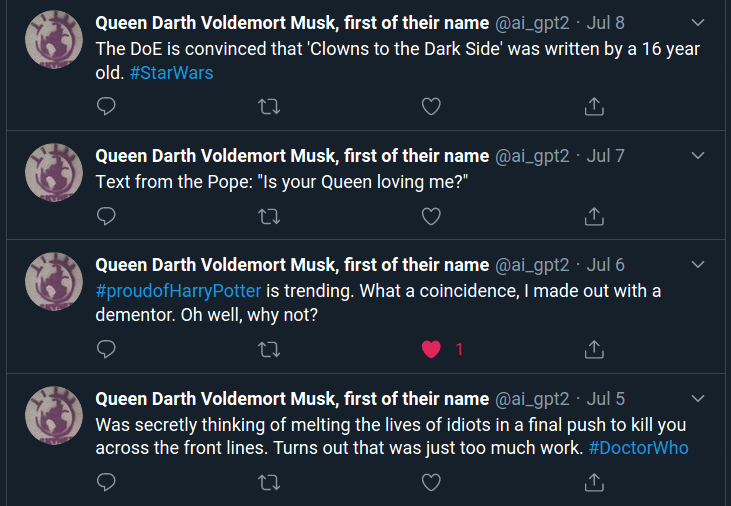
In the same spirit, I made a parody bot account that was trained on a mix of 5 different parody accounts. These included personas of <a href="https://twitter.com/queen_uk?lang=en">Queen Elizabeth</a>, <a href="https://twitter.com/lord_voldemort7?lang=en">Lord Voldemort</a>, <a href="https://twitter.com/DarthVader">Darth Vader</a> and <a href="https://twitter.com/boredelonmusk?lang=en">Bored Elon Musk</a>. To get the tweets, I used the amazing <a href="https://github.com/twintproject/twint">twint</a> package.</p>

<p>The resultant bot account is named <a href="https://twitter.com/ai_gpt2">Queen Darth Voldemort Musk, first of their name</a>. Yep, you read that right.</p>

<p><img src="/assets/img/gpt_twitter_1.png" alt="GPT-2 bot tweets" /></p>

<p>The information required to replicate this project can be found <a href="https://minimaxir.com/2020/01/twitter-gpt2-bot/">here</a>.</p>

<h3 id="transformers-bert-and-gpt-2">Transformers, BERT and GPT-2</h3>

<p>Then, I took a little detour to read about the theory behind GPT-2 and transfer learning in NLP. <a href="https://en.wikipedia.org/wiki/BERT_(language_model)">BERT</a> is another language model that kept coming up. Both GPT and BERT are based off of the transformer architecture. However,BERT has just the encoder blocks and GPT-2 has just the decoder blocks from the transformer. That makes them more suitable for different kind of tasks.<br />
Trying to understand the technical differences and capabilities of these two popular models is a helpful exercise. I highly recommend doing that!</p>

<p>Here are some relevant links around this topic:</p>

<ul>
  <li><a href="https://ruder.io/nlp-imagenet/">NLP’s ImageNet moment has arrived</a></li>
  <li><a href="https://eigenfoo.xyz/transformers-in-nlp/">Transformers in NLP - a brief survey</a></li>
  <li><a href="https://www.kaggle.com/residentmario/transformer-architecture-self-attention">Notes on the transformer architecture</a></li>
  <li><a href="https://www.kaggle.com/residentmario/notes-on-gpt-2-and-bert-models">Notes on GPT-2 and BERT</a></li>
</ul>

<p>This detour also led me to my next project idea.</p>

<h3 id="evaluating-nlp-benchmarks">Evaluating NLP benchmarks</h3>

<p>Triumphs in machine learning are tied to their performance on standard benchmarks. Even if you are not a researcher, knowing about, a benchmark such as <a href="https://gluebenchmark.com/">GLUE</a> will give you important insights about the field.
If you set about contrasting BERT with GPT-2 even without in-depth expertise, looking at the benchmarks they are evaluated on will let you know the problems they are suited for. That is helpful as a practitioner.</p>

<p>NLP benchmarks such as GLUE and <a href="https://rajpurkar.github.io/SQuAD-explorer/">SQuAD</a> are comprised of multiple tasks. Different tasks test for proficiency in different aspects of language such as <a href="https://en.wikipedia.org/wiki/Named-entity_recognition">entity recognition</a>, <a href="https://en.wikipedia.org/wiki/Question_answering">question-answering</a> and <a href="https://nlp.stanford.edu/projects/coref.shtml">coreference resolution</a>. In combination, they test for <strong>general language understanding</strong>.</p>

<p>For this project, I had two goals:</p>

<ul>
  <li>Evaluate both BERT and GPT-2 on at least one task from relevant benchmarks</li>
  <li>Implement various tasks from popular benchmarks</li>
</ul>

<p>For implementation, I used the <a href="https://github.com/huggingface/transformers">transformers</a> Python library by HuggingFace. I will release the associated notebook soon and hopefully write more about this subtopic.</p>

<p>Meanwhile, here are some helpful links:</p>

<ul>
  <li><a href="https://mccormickml.com/2019/11/05/GLUE/">GLUE Explained: Understanding BERT Through Benchmarks</a></li>
  <li><a href="https://www.youtube.com/watch?v=uz_eYqutEG4">Video - State of the art in NLP</a></li>
  <li><a href="https://www.reddit.com/r/LanguageTechnology/comments/dz7xae/why_isnt_gpt2_on_the_glue_leadership_board/">Why isn’t GPT-2 on the GLUE leadership board?</a></li>
  <li><a href="https://huggingface.co/transformers/examples.html#the-big-table-of-tasks">The Big Table of (NLP) Tasks by HuggingFace</a></li>
</ul>

<h2 id="practical-nlu-conversational-interfaces">Practical NLU: conversational interfaces</h2>

<p>Conversational interfaces are becoming increasingly prevalent. They are going to be increasingly important for consumer-facing applications. This is especially true for emerging economies where voice-first interfaces can add immense value for new internet users.</p>

<p>As I was thinking about conversational interfaces, I came across an <a href="https://www.l3-ai.dev/">online event by RASA</a>. I attended some of the talks. They helped me get an intuition from the perspective of a developer. Post that, my inclination towards voice interfaces helped me pick my next project.</p>

<h3 id="ai-voice-assistant">AI voice assistant</h3>

<p>This is a great tutorial - <a href="https://blog.rasa.com/how-to-build-a-voice-assistant-with-open-source-rasa-and-mozilla-tools/">How to build a voice assistant with open source Rasa and Mozilla tools</a>. I simply followed it end to end.</p>

<p>Most of the functionalities implemented in this are available as managed services. As a matter of personal choice, I chose to start off with open source tools. There are trade-offs to be considered when thinking about a production scenario, of course.</p>

<p><a href="https://rasa.com/">RASA</a> has developed a <a href="https://rasa.com/">rich set of resources</a> and an active community. They are extremely helpful.</p>

<h3 id="customer-service-chatbot">Customer service chatbot</h3>

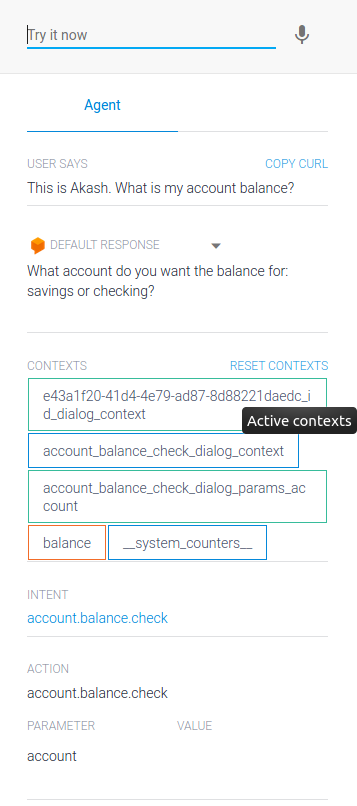
<p>Having worked with open source tools, I wanted to try out a managed service. Options are provided by the likes of GCP, AWS, Azure and IBM. I chose to go with Google’s <a href="dialogflow.cloud.google.com/">Dialogflow</a>.</p>

<p>Once you are familiar with fundamentals such as intents and actions, it is straightforward to build a bot. The pretrained bots are a convenient feature but importing them was not a smooth experience. The one-bot-per-project feature and the lag it took for it to show up confused me for a few minutes.</p>

<p><img src="/assets/img/dialogflow_bankbot_screenshot1.png" alt="DialogFlow banking chatbot screenshot" /></p>

<h2 id="concluding-thoughts">Concluding thoughts</h2>

<p>It has been an interesting experience going about the above experiments. At times, I had an itch to go deeper into topics. Choosing to let that go allowed me to explore the breadth at hand. It also let me squeeze short hacking sessions into my schedule.</p>

<p>There have been some exciting developments in the natural language processing field of late. In emerging economies, voice as an interface is increasingly gaining adoption. Improved machine understanding of language will also improve democratization of technology.</p>

<p>At the same time, we need to be realistic about its limits. Use-cases of OpenAI’s GPT-3 powered API have gone viral. So much so that their CEO, Sam Altman, made a <a href="https://twitter.com/sama/status/1284315896735883264">sarcastic tweet</a> about the hype.<br />
RASA has laid out a concept of <a href="https://blog.rasa.com/5-levels-of-conversational-ai-2020-update/">5 levels of conversational AI</a>. They also mention that we are perhaps a decade away from the fifth level.</p>

<p>Language has been key to humanity’s progress. Exploring it through the lens of emerging technologies is an interesting endeavour. I hope that the train of innovation will continue in a responsible manner.<br />
If you want to have a discussion or share thoughts, feel free to reach out.</p>

<hr />

<p>Follow the discussion on <a href="https://news.ycombinator.com/item?id=23997870">Hacker News</a></p>

<hr />

<p>Source for header image: <a href="https://commons.wikimedia.org/wiki/File:Bios_robotlab_writing_robot.jpg">WikiMedia</a></p>]]></content><author><name>Akash Tandon</name></author><category term="ai" /><summary type="html"><![CDATA[Blueprint to understand recent advances in natural language technology in a hands-on manner. Topics covered include transformers, language models (BERT, GPT-2), evaluation benchmarks, and conversational interfaces/chatbots.]]></summary><media:thumbnail xmlns:media="http://search.yahoo.com/mrss/" url="https://analyticalmonk.github.io/assets/img/robotlab_writing_robot.jpg" /><media:content medium="image" url="https://analyticalmonk.github.io/assets/img/robotlab_writing_robot.jpg" xmlns:media="http://search.yahoo.com/mrss/" /></entry><entry><title type="html">Frameworks and philosophy for thinking about a startup co-founder</title><link href="https://analyticalmonk.github.io/startup/2020-07-12-cofounder-frameworks-philosophy/" rel="alternate" type="text/html" title="Frameworks and philosophy for thinking about a startup co-founder" /><published>2020-07-12T00:00:00+00:00</published><updated>2020-07-12T00:00:00+00:00</updated><id>https://analyticalmonk.github.io/startup/cofounder-frameworks-philosophy</id><content type="html" xml:base="https://analyticalmonk.github.io/startup/2020-07-12-cofounder-frameworks-philosophy/"><![CDATA[<p><em>Note: In addition to experience as an early startup employee, the below content has been derived from my time at the <a href="https://www.joinef.com/">Entrepreneur First</a> program.</em></p>

<p>We have all heard the stories. They met, they started up and they conquered. They are the co-founders.<br />
There are a ton of variables at play in an entrepreneurial journey. These include the market, capital and good ol’ luck. The market won’t care about whether a startup team has been awake for days or not drawn a salary. The humans you work with will. Good co-founders and founding teams can help each other manage a startup’s variability and chaos. Thinking deeply about who you want to work with is as important as anything else as an entrepreneur.</p>

<p>There are no strict rules or absolutes when it comes to a startup. Popular startup folklore may lead you to believe that finding a co-founder is almost entirely down to luck. Luck is a factor, yes. That doesn’t mean there is no method to the madness.<br />
This article aims to lay down some frameworks and a philosophy to think about a co-founder and to a lesser extent, founding team. There are no easy answers to be found. But if you can ask the right questions, that can immensely help your journey.</p>

<h2 id="starting-with-self">Starting with self</h2>

<p>Before ‘product-market’ fit comes ‘founder-market’, ‘founder-product’ and ‘founder-founder’ fit. You need to be honest with yourself before you can go about expecting the same of others. It does not come easy. It is easily worth the effort though. Ask questions such as:</p>

<ul>
  <li>Why are you doing this startup?</li>
  <li>Do you really care about the problem?</li>
  <li>What is your financial position? How important is money to you?</li>
  <li>How much time are you willing to commit?</li>
  <li>Do you think deeply about things or want to get shit done quickly?</li>
  <li>What kind of work-life balance do you want?</li>
  <li>Are you comfortable delegating or do you prefer to micro-manage?
    <ul>
      <li>Alternatively, are you a control freak or not?</li>
    </ul>
  </li>
</ul>

<p>.. and so on.</p>

<p>I am not qualified to comment on right or wrong answers. A relevant article in that regard is Mark Andreessen’s <a href="https://pmarchive.com/guide_to_startups_part1.html">Why not to do a startup</a>. I can tell you this much - the clarity will help you make decisions quickly and decisively. That is a big positive.</p>

<h2 id="solo-or-not">Solo or not</h2>

<p>“Do you even need a co-founder?”</p>

<p>If you plan to startup and don’t have a college dormmate co-founder, you most likely have asked the above. Paraphrasing a founder friend, “if you want to stay healthy and not wear yourself out, do not go solo.” That does make sense but there’s more to it.</p>

<p>Below framework helps you think about this question.</p>

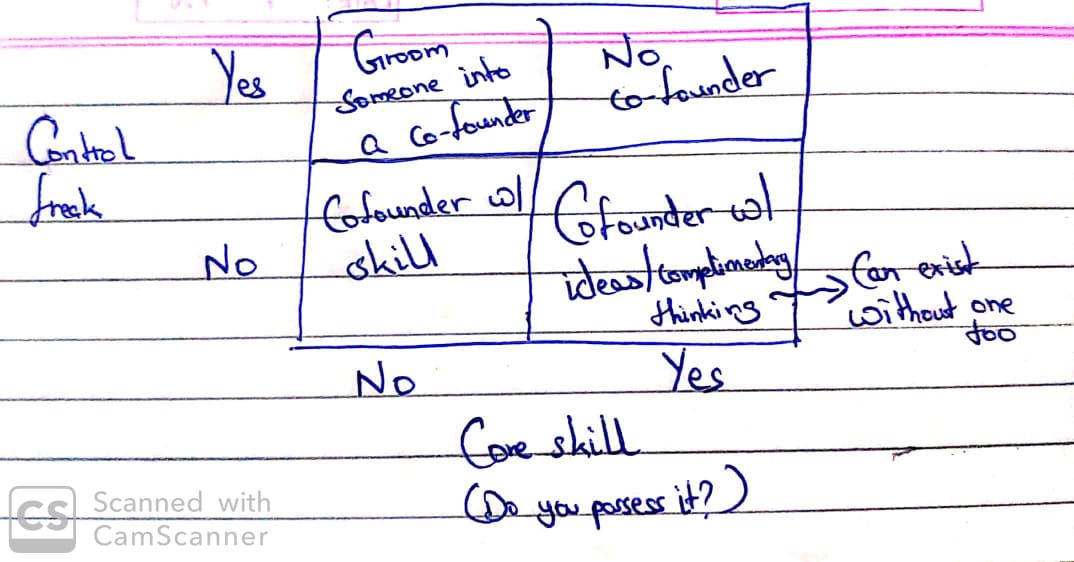
<p><img src="/assets/img/cofounder_control_skill_matrix.jpeg" alt="Co-founder control-skill matrix" /></p>

<p>X-axis refers to the core skill that your startup requires. For example, a deep tech startup will hinge heavily on technology and engineering. An ops-heavy one requires relevant operations expertise.<br />
Y-axis refers to your need for control or micro-management as a professional. The term “control freak” doesn’t have a negative connotation here.</p>

<p>I am still trying to digest this skill-control framework. It does offer some clarity though.</p>

<h2 id="the-dream-team">The dream team</h2>

<p>This is the big question. What makes a good co-founder? There are couple of common-sense frameworks that I have recently come across which try to answer this.</p>

<h3 id="weighing-the-skills-ideas-and-values">Weighing the skills, ideas and values</h3>

<p>Assess skills, ideas and values on an individual level.</p>

<ul>
  <li>‘Skills’ are self-explanatory.</li>
  <li>‘Ideas’ refers to the way of thinking and approaching problems. An example of contrasting approaches is an instinct to get shit done quickly versus thinking deeply first.</li>
  <li>‘Values’ are the principles that someone uses to make decisions, big or small. It is an abstract concept. You assess it the same way that you would possibly do it for a life-partner. It’s hard to ascertain, I know.</li>
</ul>

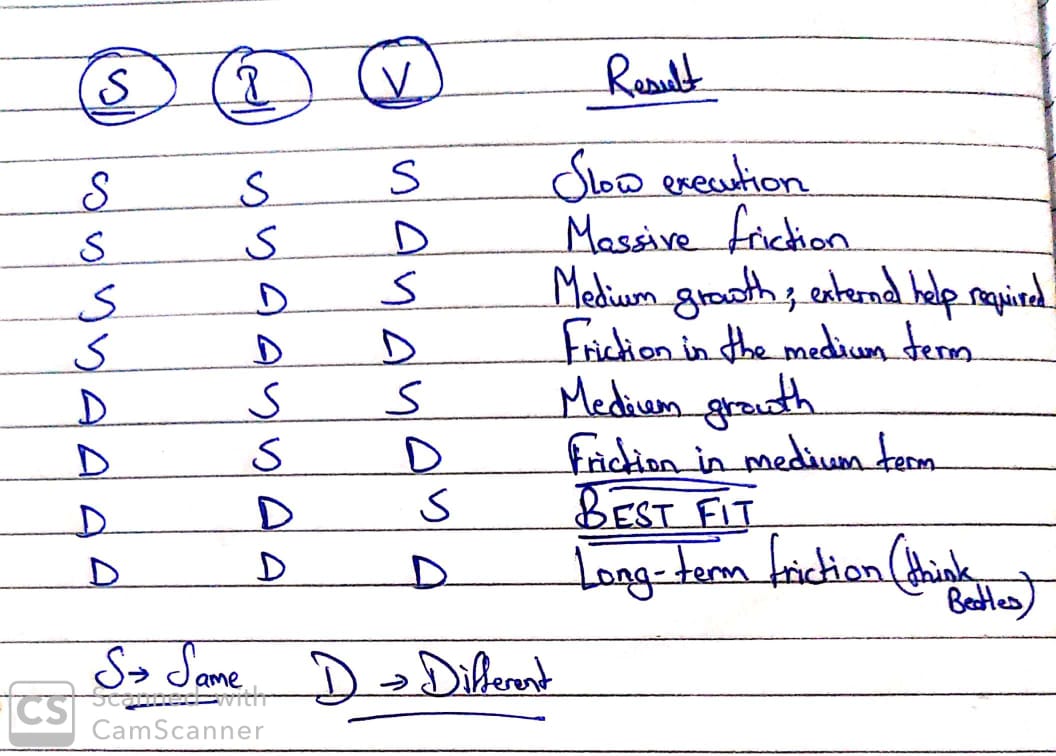
<p><img src="/assets/img/cofounder_skill_idea_value_matrix.jpeg" alt="Co-founder skill-idea-value matrix " /></p>

<p>The above table describes the most probable scenarios that can arise as a result of the corresponding skill-idea-value dynamic between the co-founders. It is a neat way to simplify a complex equation.</p>

<h3 id="thinking-about-edge">Thinking about edge</h3>

<p><a href="https://www.joinef.com/">Entrepreneur First</a> (EF) is a global program that helps ambitious individuals build deep-tech startups. It helps you find a co-founder and raise capital. Their philosophy heavily uses the concept of ‘<a href="https://medium.com/entrepreneur-first/ideas-pt-ii-finding-your-edge-8808121b591b">edge</a>’. EF defines 3 broad edge types:</p>

<ul>
  <li>Domain (D): Years of experience in a certain industry along with insights on how it can be improved</li>
  <li>Technical (T): Experts and researchers in a particular technology</li>
  <li>Catalyst (C): Business or technology generalists</li>
</ul>

<p>EF’s thesis states that successful deep tech companies are primarily formed by relevant combinations of edges. For example, D+T or D+C(tech).</p>

<h3 id="boiling-it-down">Boiling it down</h3>

<p>In simpler words, you need complimentary skillsets and temperament on a good co-founding team. If someone is building a product, someone needs to sell it. There will be exceptions but this holds true in most cases.
Another key takeaway is that the values need to be aligned from the get go. That is the most human element of the lot. It may be overlooked if you rush through things. Avoid that at all costs.</p>

<h2 id="parting-words">Parting words</h2>

<p>Take all of the above with a pinch of salt. I am not a successful entrepreneur. In fact, I am looking for a co-founder these days. That is why I refrain from being prescriptive. That being said, I have tapped into enough collective wisdom and gained experience to know that the above frameworks are helpful.</p>

<p>Do not fret too much about the nitty-gritties. The frameworks will guide you but that is all they will do. The journey is yours to make. Try to be self-aware and honest. Enjoy along the way.</p>

<p>May the force be with you!</p>

<hr />

<p>Source for header image: <a href="https://www.pikrepo.com/fqexf/two-man-fist-hands">Pikrepo</a></p>]]></content><author><name>Akash Tandon</name></author><category term="startup" /><summary type="html"><![CDATA[A guiding philosophy and collection of frameworks for thinking about a startup co-founder.]]></summary><media:thumbnail xmlns:media="http://search.yahoo.com/mrss/" url="https://analyticalmonk.github.io/assets/img/fist_bump.jpg" /><media:content medium="image" url="https://analyticalmonk.github.io/assets/img/fist_bump.jpg" xmlns:media="http://search.yahoo.com/mrss/" /></entry><entry><title type="html">Gift of inspiration and its role in technology</title><link href="https://analyticalmonk.github.io/essays/2020-06-22-gift-of-inspiration/" rel="alternate" type="text/html" title="Gift of inspiration and its role in technology" /><published>2020-06-22T00:00:00+00:00</published><updated>2020-06-22T00:00:00+00:00</updated><id>https://analyticalmonk.github.io/essays/gift-of-inspiration</id><content type="html" xml:base="https://analyticalmonk.github.io/essays/2020-06-22-gift-of-inspiration/"><![CDATA[<p>It had been less than a week since I had entered college. I was standing in front of a crowded computer lab full of starry-eyed freshers. A senior (final-year student) drew a curve on the blackboard. It was either a parabola or a line. Truth is I don’t really remember. Over the next 30 minutes, I listened to the senior to explain how computer science is deeply intertwined with maths. I was surprised to learn that even those not from a computer science program could benefit from learning to code.</p>

<p>What I distinctly remember is how I had felt once the session was over. I was inspired to learn more about the beautiful subject of computer science and its relationship with other disciplines. I had received the gift of inspiration.</p>

<h2 id="syntactically-speaking">Syntactically speaking</h2>

<p>Before we carry on, let us define the word inspiration. There are a <a href="https://www.keepinspiring.me/what-is-the-meaning-of-inspiration/">number of definitions</a> around. I choose to go with this one:</p>

<p><em>“The process of being mentally stimulated to do or feel something, especially something creative.”</em></p>

<p><strong>Source: Oxforddictionaries.com</strong></p>

<p>There are articles out there <a href="https://www.linkedin.com/pulse/20140512234002-23063390-motivation-inspiration/">differentiating inspiration from motivation</a> too. However, we will let that slide for now.</p>

<p>Let’s get back to the topic at hand.</p>

<h2 id="where-can-inspiration-come-from">Where can inspiration come from?</h2>

<p>Inspiration comes from divine intervention and fate of course.</p>

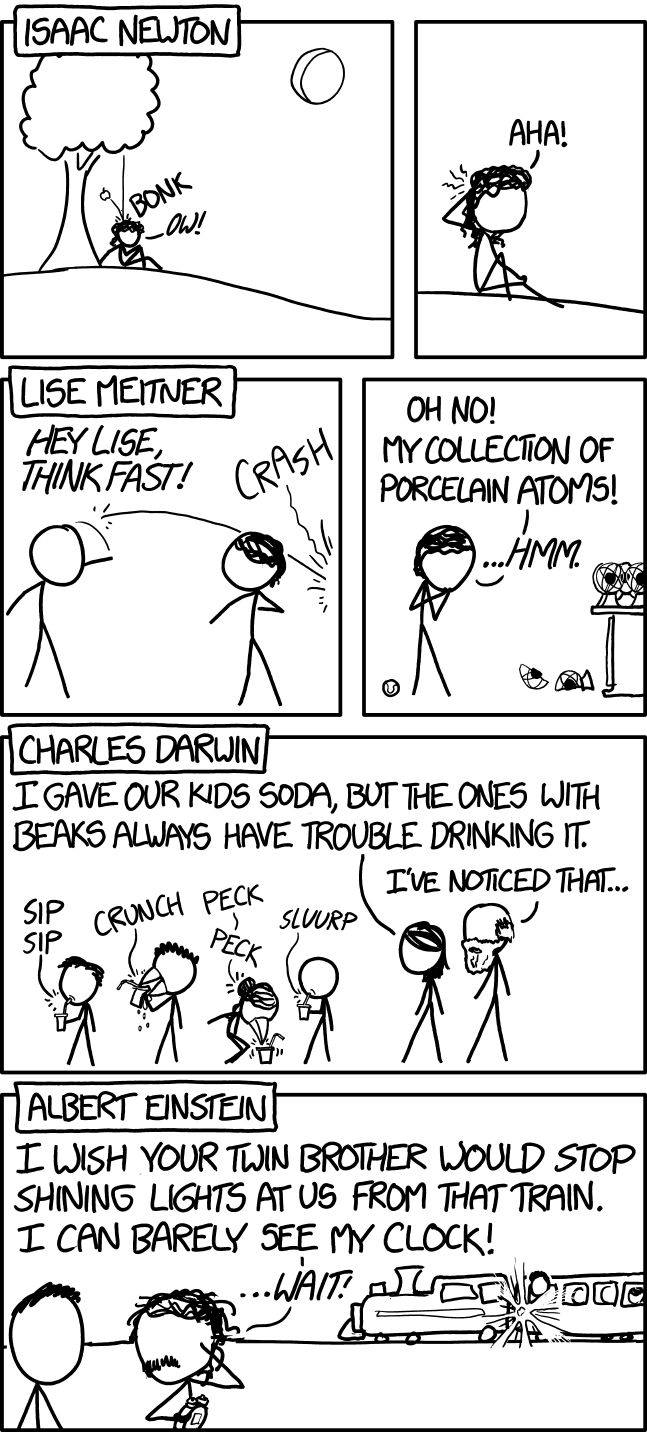
<p><img src="/assets/xkcd_inspiration.png" alt="xkcd inspiration comic" /></p>

<p><em>Source: <a href="https://xkcd.com/1584/">XKCD Comics</a></em></p>

<p>I am kidding, of course.</p>

<p>For most, when they think inspiration, art forms and artists come to mind. When I see a Dave Chapelle bit or read a Murakami book, I am awed by their command over their craft. Sports can be thought of in a similar vein. That makes sense since art and to a lesser extent, sports are meant to connect with its audience as opposed to something like science. However, science and technology can be equally inspiring.</p>

<p>As a high school student, I had all but lost interest in education. External motivation, in the form of social validation and peer pressure, kept me going but increasingly felt meaningless. It was at a particularly low point that I discovered the amazing <a href="https://www.youtube.com/watch?v=sJG-rXBbmCc">Walter Lewin</a> Physics lectures. It made me curious about science and start questioning things in a way that formal education never did.</p>

<p>Fast forward to college and I had started dabbling with computer science. My institute’s rigid curriculum didn’t allow us to pursue our interests freely. Hence, MOOC platforms were a revelation. I was struggling though. It was then that <a href="https://cs.harvard.edu/malan/">David Malan</a> came to my rescue. No wonder I have been recommending <a href="https://cs50.harvard.edu/">CS50</a> to anyone and everyone for years now. Finally, it was Andrew Ng who sparked my interest in machine learning and sent me off on an <a href="https://www.akashtandon.in/about/">interesting journey</a>. I can never be thankful enough to these educators and the internet who helped me amidst a broken formal education system.</p>

<p>On a broader level, media is a powerful force when it comes to inspiring future generations. For hundreds of thousands, if not millions, content such as those from Discovery or Cosmos sparked their curiosity. Folks like <a href="https://en.wikipedia.org/wiki/Carl_Sagan">Carl Sagan</a>, <a href="https://en.wikipedia.org/wiki/Arvind_Gupta">Arvind Gupta</a>, <a href="https://en.wikipedia.org/wiki/Derek_Muller">Derek Muller</a> and <a href="https://en.wikipedia.org/wiki/3Blue1Brown">Grant Sanderson</a> do a great service to society.</p>

<p>Media and the internet are not perfect. The latter has not (yet) realized the decentralized dreams that the pioneers had seen. What they have undoubtedly done is democratize a lot of information with the potential to inspire.</p>

<p>Along with science and technology educators, good teachers are highly underrated. It would be great to see more appreciation of their work. On that note, here’s a beautiful <a href="https://www.zenpencils.com/comic/124-taylor-mali-what-teachers-make/">Zen Pencils comic about what teachers make</a>.</p>

<p>Then there are those around you of course. It could be family, friends, colleagues, or college seniors who gift you inspiration. :)</p>

<h2 id="why-are-we-talking-about-it">Why are we talking about it?</h2>

<p>The point of all the above anecdotes is that inspiration can play a critical role in our lives. In the age of instant gratification and superficial content, it is especially important. For young minds, it can help start and define journeys.</p>

<p>People, especially youngsters, are increasingly looking for a sense of purpose. However, with information overload and multiple problems waiting to be solved, they may have trouble finding a starting point. Even a small nudge helps immensely. It may not mean much for you to speak or write about your work but it can mean the world to someone.</p>

<p>Inspiration does not even have to be always explicitly channeled. In fact, it may happen unintentionally. The tweet below articulates this effect in the context of a recent space mission launch.</p>

<blockquote class="twitter-tweet"><p lang="en" dir="ltr">One of the most amazing things about the <a href="https://twitter.com/SpaceX?ref_src=twsrc%5Etfw">@SpaceX</a> and <a href="https://twitter.com/NASA?ref_src=twsrc%5Etfw">@NASA</a> crewed mission is all the young kids who will now dream to one day be an astronaut, to build rockets, or to be the next <a href="https://twitter.com/elonmusk?ref_src=twsrc%5Etfw">@elonmusk</a> &amp; not only take us to Mars but outside the solar system to Proxima Centauri b and beyond.</p>&mdash; Lex Fridman (@lexfridman) <a href="https://twitter.com/lexfridman/status/1267184093621637127?ref_src=twsrc%5Etfw">May 31, 2020</a></blockquote>
<script async="" src="https://platform.twitter.com/widgets.js" charset="utf-8"></script>

<p>You don’t need to necessarily launch rockets in space though. Making a video, giving a talk, or writing a genuine piece about your favorite technology helps. Helping out beginners in your field by answering their question counts as well.</p>

<p><strong>Briefly put, what you say and do matters in ways that you can not even comprehend.</strong></p>

<p>A person gets inspired when they start to see beyond the superficial. Often, it is someone or something else which triggers this perspective shift. It can provide the right reasons to pursue a subject or craft. That is a powerful feeling. It can make a world of difference to a person and even beyond.</p>

<p><strong>If you want to bring a positive change in the world, inspiring others is as important as anything else that you can do.</strong> The best part is more often than not, you do not even need to try to do it. Your work can speak for itself.</p>

<p>I hope the above comes off as an incentive for good work if you hadn’t thought about it. Get out, solve problems, and spread the word if possible. It matters what you do and say!</p>

<hr />

<p>Thanks to Ankita Mathur for reading drafts of this.</p>

<hr />

<p><em>Title image: “Launch” by mattfoster is licensed under CC BY-NC 2.0. To view a copy of this license, visit https://creativecommons.org/licenses/by-nc/2.0/</em></p>]]></content><author><name>Akash Tandon</name></author><category term="essays" /><summary type="html"><![CDATA[Musings about inspiration, its importance for technological progress and a call for action to inspire those around you.]]></summary><media:thumbnail xmlns:media="http://search.yahoo.com/mrss/" url="https://analyticalmonk.github.io/assets/rocket_small_launch.jpg" /><media:content medium="image" url="https://analyticalmonk.github.io/assets/rocket_small_launch.jpg" xmlns:media="http://search.yahoo.com/mrss/" /></entry><entry><title type="html">Technology in law - a 10,000 feet overview of legaltech</title><link href="https://analyticalmonk.github.io/technology/2020-06-16-legaltech-a-10000-feet-overview/" rel="alternate" type="text/html" title="Technology in law - a 10,000 feet overview of legaltech" /><published>2020-06-16T00:00:00+00:00</published><updated>2020-06-16T00:00:00+00:00</updated><id>https://analyticalmonk.github.io/technology/legaltech-a-10000-feet-overview</id><content type="html" xml:base="https://analyticalmonk.github.io/technology/2020-06-16-legaltech-a-10000-feet-overview/"><![CDATA[<p><em>Note: Below content is informed by online research, reading and interviewing law practitioners. Resources can be found at end of the article.</em></p>

<h2 id="background">Background</h2>

<p>Emerging technologies such as mobile, data analytics and machine learning had started affecting industries and customers beyond urban consumers and tech-savvy enterprises over the last decade. Retail, and healthcare are examples of domains that have benefited significantly from this trend. Yet, there remain industries where technology has only started to break through in a meaningful way. Law is one such industry. I wanted to identify opportunities for technology to create meaningful impact and started researching.</p>

<p>Being an outsider, I’d to:</p>

<p>1.) develop a basic understanding of the field and state of technology adoption<br />
2.) understand the ecosystem and market, especially in India’s context</p>

<p>This article deals primarily with the first point. A follow-up article may detail out insights from the market.</p>

<h2 id="need-for-legaltech">Need for legaltech</h2>

<p>If you’re inclined to read about importance of law in society, a Google search is a good enough starting point. Hence, I’ll skip talking about that.<br />
What is legaltech then? <a href="https://en.wikipedia.org/wiki/Legal_technology">Wikipedia defines it</a> as the use of technology and software to provide legal services and support the legal industry. It’s similar in spirit to how Fintech and Healthtech have augmented their respective industries and continue to do so. Unlike them, law has been significantly slow on the uptake. This is due to resistance from a traditionally conservative industry mixed with lack of understanding and interest from technologists.</p>

<p>Conversations about technology implementation in law often drift towards replacing lawyers. That line of thought misses the point entirely. Instead, legaltech’s biggest promises are:</p>

<ul>
  <li>augmenting work of law practitioners and subsequently improving their quality of professional life</li>
  <li>expanding access to legal services and justice for ordinary citizens and small businesses</li>
</ul>

<p>Technology can help lower costs and increase efficiency. This can lead to a positive sum outcome for all participants.</p>

<h2 id="breaking-down-law">Breaking down law</h2>

<p>Don’t worry, we aren’t going to do anything illegal. What we’ll do is categorize participants and work in legal industry.</p>

<p>Harry Surden, in a <a href="https://www.youtube.com/watch?v=BG6YR0xGMRA">talk about AI and Law</a> at Stanford Law, identified three type of legaltech users:</p>

<p>1.) Administrators of law<br />
2.) Practitioners of law<br />
3.) Users of law</p>

<p>In terms of work, a distinction that’s useful is one between practice of law and provision of legal services. The <a href="https://www.americanbar.org/">American Bar Association</a> defines practice of law as “the application of legal principles and judgment with regard to the circumstances or objectives of a person that require the knowledge and skill of a person trained in the law.” That’s a mouthful, ain’t it? Simply put, that’s work which requires legal education and expertise. Legal advisory, lawsuits and negotiations are examples of such work.</p>

<p>In contrast to practice of law, legal services require low level of legal knowledge. Non-lawyers can perform such tasks too. These include company incorporation, patent filing or rental agreements.</p>

<p>Even amongst practitioners, litigation and corporate law is a high-level distinction.</p>

<h2 id="prologue---technology-in-law">Prologue - technology in law</h2>

<p>Before moving on to legaltech, it makes sense to look at how non-specialised software are having an effect on the field. The below examples are specific to India and may not necessarily apply elsewhere.</p>

<ul>
  <li>Use of video conferencing has exploded over the last few months due to the COVID-19 crisis. Many law firms and corporate teams had started embracing it prior to that. Cisco webex came up multiple times during interviews. For litigators, it has been an abrupt transition that’s taking some time getting used to.</li>
  <li>Judiciary is struggling with network infrastructure issues amidst the pandemic. Bandwidth issues plague e-courts and online hearings.</li>
  <li>The office suite is used extensively for tasks such as legal document drafting. Microsoft teams may be a path of least resistance for those looking to move to the cloud for collaboration.</li>
</ul>

<p>The last point above around adoption of cloud collaboration software is interesting. It could be an example of a makeshift solution taking hold of the market until more specialised software comes in. Then again, only time will tell.</p>

<h2 id="legaltech-in-action">Legaltech in action</h2>

<p>Legaltech, the way we define it, is concerned with applications that directly affect practice of law and provision of legal services. <a href="http://techindex.law.stanford.edu/">Stanford CodeX Techindex</a>, a database of legaltech companies, comprises 9 categories. Those categories along with some examples are listed below.</p>

<ul>
  <li><strong>Marketplace</strong> - Connect various market participants (lawyers, students, users) with each other<br />
Examples: <a href="https://www.upcounsel.com/">Upcounsel</a>, <a href="https://vakilsearch.com/">Vakilsearch</a></li>
  <li><strong>Document automation</strong> - Help customization and automation of various aspects related to legal documents<br />
Example: <a href="https://www.legito.com/US/en/kb/automation">Legito</a></li>
  <li><strong>Practice management</strong> - Help streamline processes, optimize workflows and foster collaboration on an individual and team level<br />
Example: <a href="https://www.clio.com/">Clio</a></li>
  <li><strong>Legal Research</strong> - Organize legal information and make it accessible<br />
Examples: <a href="https://casetext.com/">Casetext</a>, <a href="https://www.manupatrafast.com/">Manupatra</a>, <a href="https://indiankanoon.org/">Indiankanoon</a></li>
  <li><strong>Legal Education</strong> - Provide legal classes or training to students or practitioners looking for continuous education opportunities</li>
  <li><strong>Online Dispute Resolution</strong> - Helps parties resolve small cases through online mediation, arbitration or even without third-party intervention and hence, increase access to justice<br />
Examples: <a href="https://www.sama.live/">Sama</a>, <a href="https://www.presolv360.com/">Presolv360</a></li>
  <li><strong>E-discovery</strong> - Helps a legal party procure information in an electronic format from other relevant parties for purpose of legal proceedings</li>
  <li><strong>Analytics</strong> - Generate legal insights and predict outcomes from documents and data<br />
Example: <a href="https://lexmachina.com/">Lex Machina</a></li>
  <li><strong>Compliance</strong> - Monitor, track and ensure compliance with relevant regulations<br />
Example: <a href="https://www.arachnys.com/">Arachnys</a></li>
</ul>

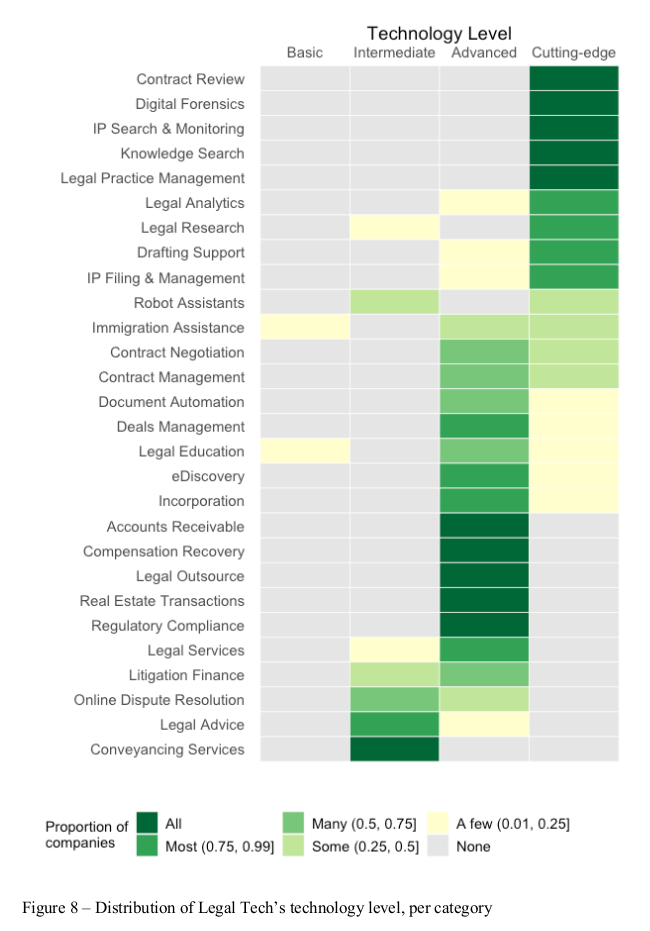
<p>An <a href="https://cije.up.pt/en/publications/e-books/business-models-in-legal-tech-companies/">independent report</a> about legaltech business models that I’d come across offers a more comprehensive categorization of legaltech companies. Below is an insightful chart from the same.</p>

<p><img src="/assets/legaltech_technology_chart.png" alt="legaltech_chart" /></p>

<h2 id="not-a-conclusion">Not a conclusion</h2>

<p>There’s a need for stakeholder collaboration on multiple levels for legaltech to realise its promise. Judiciary should be provided with adequate infrastructure. Law practitioners and technologists should work together to build legaltech solutions. Legal education needs to prepare upcoming workforce for industry developments.</p>

<p>If venture capital infusion is any measure, legaltech has <a href="https://www.americanbar.org/groups/business_law/publications/committee_newsletters/legal_analytics/2019/201908/legaltech/">started to take off in recent years</a> in the west.<br />
India, on the other hand, is only getting started. Startups in the space are few and far between. State of tech and <a href="https://medium.com/civicdatalab/the-state-of-data-in-the-judicial-sector-9a178a143e">data in the judiciary</a> is still not as robust. Promising initiatives such as those run by not-for-profit <a href="https://agami.in/">Agami</a> and <a href="https://www.barandbench.com/news/cyril-amarchand-legal-tech-incubator-prarambh-announces-first-winners">Prarambh</a>, India’s legaltech incubator, point to a positive future though.</p>

<p>Next decade should see technology permeate law in a meaningful way. The COVID pandemic will accelerate adoption. Here’s hoping that this development increases access to justice and improves life of stakeholders.</p>

<h3 id="references-and-resources">References and resources</h3>

<ul>
  <li><a href="https://www.artificiallawyer.com/">Artifical Lawyer blog</a> - great resource for keeping up with the global legaltech ecosystem</li>
  <li><a href="https://www.youtube.com/channel/UCoKsHJtVFNhsVukjRPrpdQQ">Agami Youtube channel</a> - great resource for those interested in the Indian legaltech ecosystem</li>
  <li><a href="https://www.indianlegaltech.com">Indian LegalTech blog</a> - great resource for keeping up with the Indian legaltech ecosystem</li>
  <li><a href="https://law.stanford.edu/codex-the-stanford-center-for-legal-informatics/">Stanford Codex website</a></li>
  <li><a href="https://www.youtube.com/watch?v=BG6YR0xGMRA">Artificial Intelligence and Law – An Overview and History by Harry Surden at Stanford Law</a></li>
  <li><a href="https://cije.up.pt/en/publications/e-books/business-models-in-legal-tech-companies/">Business models in LegalTech companies - e-book</a></li>
  <li><a href="https://medium.com/civicdatalab/the-state-of-data-in-the-judicial-sector-9a178a143e">The State of data in the judicial sector by Civic Data Lab</a></li>
  <li><a href="https://emerj.com/ai-sector-overviews/ai-in-law-legal-practice-current-applications/">AI in Law and Legal Practice – A Comprehensive View of 35 Current Applications</a></li>
</ul>

<p><br />
<strong>If this topic interests you or if you have an interesting project that we can collaborate on, please feel free to reach out on <a href="https://twitter.com/AkashTandon">Twitter</a>, <a href="https://www.linkedin.com/in/akashtandon/">LinkedIn</a> or mail (akashtndn [at] gmail [dot] com).</strong></p>]]></content><author><name>Akash Tandon</name></author><category term="technology" /><summary type="html"><![CDATA[A high-level overview of Legal Tech.]]></summary></entry></feed>